Agreed scope, with a record.
Keep the version the customer approved, the materials they saw and any separately agreed additions connected to the work.
Signature and stage rules checked for the chosen documentsPre-Seed· Private beta· Founder-led pilots
Conversations, agreed scope, jobs and customer documents in one context. AI helps prepare the next step; your team reviews important decisions. Founder-led pilots test one useful workflow before wider rollout.
Informational only. Not an offer to sell or a solicitation to purchase securities.
Platforms
The web workspace implements customer records, conversations, jobs, appointments, estimates, the core customer portal and selected invoice/payment processes. The current rollout is a closed, founder-led pilot: access, configuration and an agreed workflow are checked with each company before use.
The October 4 Apple snapshot showed build 91 in internal TestFlight. October 6 developer reports describe newer mobile work but do not verify the currently available Apple build or external access. The available build and its selected workflows need confirmation before an external pilot; full web parity and public App Store availability are not claimed.
Developer reports reviewed: Oct 6, 2026. Website copy updated Oct 7, 2026. Reports are distinct from independent runtime and external pilot acceptance; the dated Apple snapshot is not a latest-build claim.
The problem
Adjust the inputs for a rough sense of the money at stake when inbound isn't answered fast.
Illustrative estimate only. This calculator does not represent actual or guaranteed Bazas customer results. Values are computed in your browser and are not sent anywhere.
The product
Connect the request, approved scope, work and customer documents. Important decisions remain reviewable; the closed pilot accepts the process your company will actually use.
Keep the version the customer approved, the materials they saw and any separately agreed additions connected to the work.
Signature and stage rules checked for the chosen documentsA company-branded portal gives the customer a place to return to shared projects, documents and contact with the team.
Actions and link access accepted during onboardingDraft the invoice from agreed work. Record confirmed funds through the selected payment process; reconcile balances and receipts.
Payment notices and actual funds are separateSelected, configured web pilot workspaces. Connections differ by channel. Recipient, delivery and permissions are checked; a connected badge is not proof of receipt.
Configured number, hours and calendar. Booking and transfer to a person during business hours require scenario acceptance. New after-hours and interrupted-call handling is not presented as released.
A supported mailbox configured for the pilot. Current email setup is assisted. This is not self-service connection of any mailbox; provider access and delivery need checking.
Set up and accepted per channel and account. Some routes use external automation. Capture, actual reply delivery and the handoff policy are evaluated separately; channel coverage is not universal.
Agreed web scheduling process. Business hours, time zone, availability and staff assignment are checked during onboarding. Voice scheduling has its own acceptance.
Supported actions and configured reply policies. Pilot confirmation and separately authorised automation have different permissions. Conversation pause is not a blanket stop for every background process.
Core web pilot process. The team sees information its permissions allow. Multiple-property and legacy-record behavior must be confirmed; a complete property-management rollout is not claimed.
Agreed policies, recipients and channels. Automatic sends need separate permission and acceptance. Scheduled status does not establish delivery or a guaranteed dispatch time.
Reported deployed web document process; acceptance required. AI prepares a draft; review and sending are distinct steps. Signature requirements, payment stages, templates, tax settings and the customer's actions are checked per pilot. Approval is not a legal-contract guarantee.
Reported deployed web portal; setup and acceptance required. Available actions and link renewal are confirmed for the pilot. This does not promise all documents, unrestricted history, arbitrary rescheduling or a custom domain. Branding includes Bazas attribution; document and PDF languages vary.
Chosen payment process after financial acceptance. A customer's 'sent' notice is not proof of funds. Balances, receipts and accounting allocation are accepted together. Payment links or your payment details are distinct from an embedded Bazas card checkout; one is not promised here.
Optional connection for an agreed account and process. An account and setup are required; entity mapping, payment allocation, receipts and recovery need acceptance. QuickBooks is not required for every pilot and this is not tax filing.
Selected internal TestFlight scenarios. Requires consent and iPhone location permissions. Detailed trips belong to their driver; managers do not receive another driver's private journal. Accuracy, gaps, vehicle matching and a real PDF/CSV export remain acceptance gates; no tax-ready report is claimed.
A supported expense process agreed during onboarding. OCR, mailbox import, bank connections, tax calculations and each export require their own confirmation. The October 6 reports did not independently audit these workflows; tax filing is not offered.
Limited scope agreed with the founder. Assignment, shared history, commission calculation, recorded obligation and actual settlement are separate acceptance steps. Hidden phone numbers, bypass prevention, a multi-company dispatcher and automatic payouts are not promised.
Not available as a released pilot capability. Requires real two-way audio, corporate Caller ID, call completion and role-access acceptance before release.
A separate release and acceptance gate. Not a promise that any overnight call results in a callback, SMS or booking.
Not part of the current agreed pilot scope. Provider connection and full payment, receipt, refund and reconciliation acceptance are required; no release date is promised.
Scope reviewed against developer reports dated October 6, 2026 and the earlier source review. These are implementation reports, not a new independent runtime audit. Onboarding confirms deployment, configuration and acceptance for each company's chosen process.
Current pilot scope
Product preview
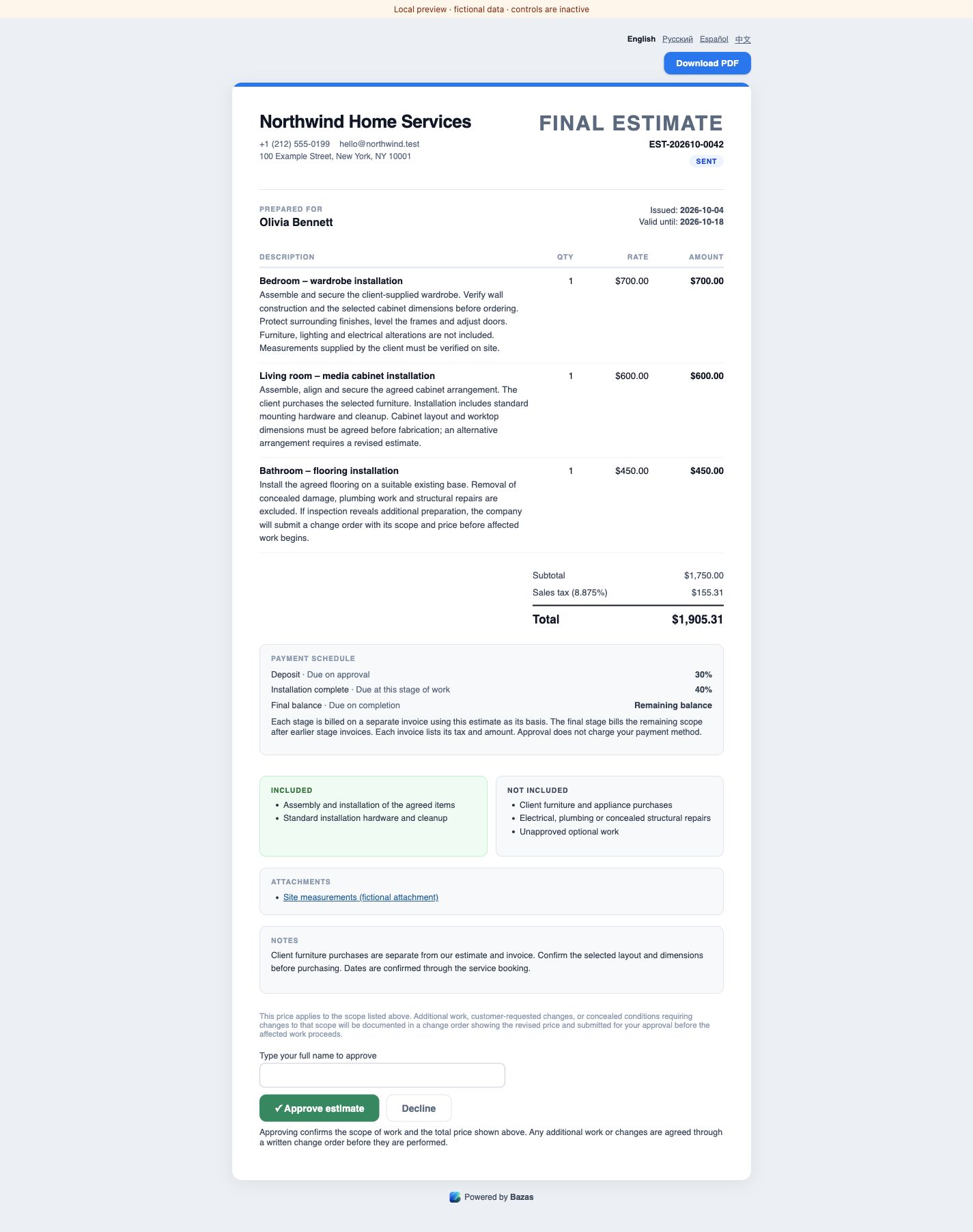
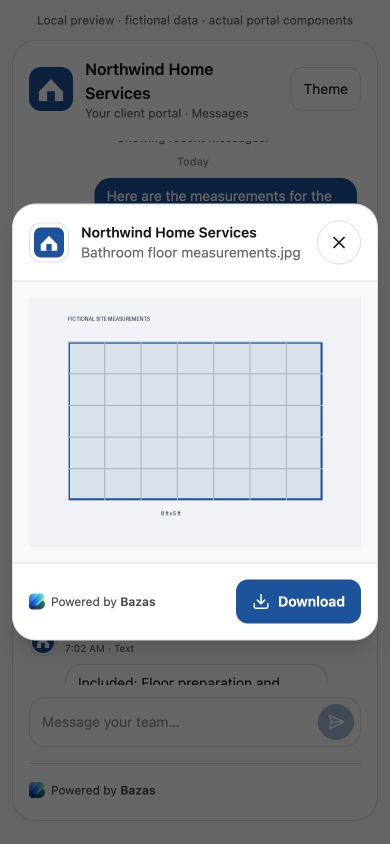
An estimate and a customer portal make the connected document experience concrete. The captures below use a local component demo and fictional records.
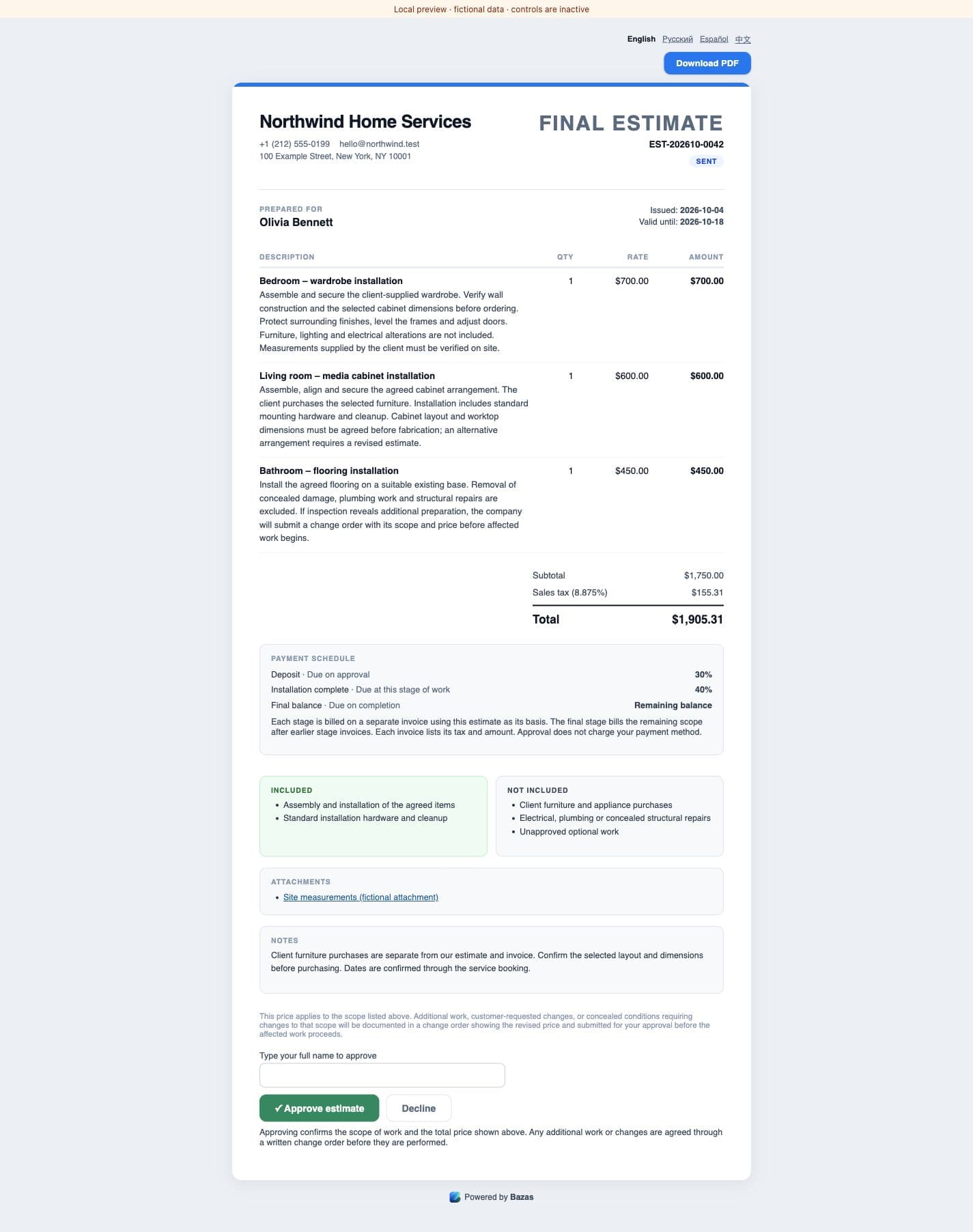

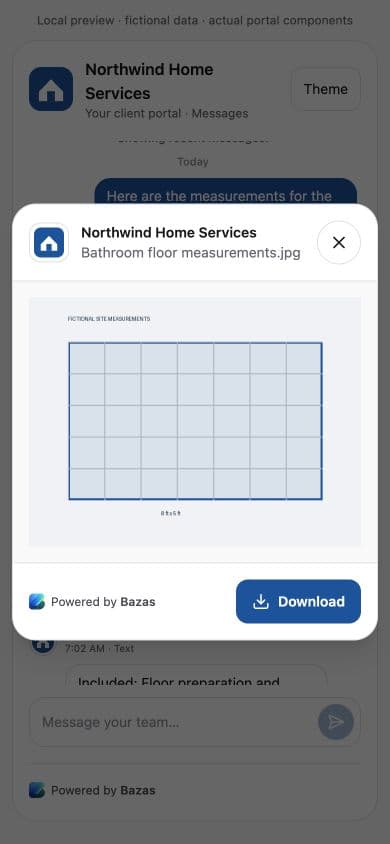
These images were captured from locally rendered product components with fictional demo records. Controls in screenshots are inactive. They show the interface concept and do not establish a live production workflow or an external customer's acceptance.
Review the actual workflow, its availability and the next acceptance gate with the founder.
Your AI dispatcher
From the first enquiry to the final follow-up. Bazas connects the conversation, the work and the next decision — so your team can focus on the customer.
We are implementing this connected dispatcher experience. Start with an agreed pilot; expand automation as each workflow is checked with your company.
Choose how much to delegate
You stay in charge. AI follows the conversation, spots missing details and prepares the next step. Reviewing a suggestion does not send a message or change a booking.
Illustrative workflow · rollout scope
Use your services, pricing and the customer’s history. Collect only the missing essentials, keep promises visible and bring the next useful step to the team.
A marketplace enquiry can continue by SMS or email without losing its context. We are connecting source-specific rules, email threads and human handoff across supported channels.
Coordinate suitable technicians, availability, job duration and travel. Handle changes and cancellations, and alert a person when a decision or response is missing.
Connect preliminary estimates, customer approval, attachments, additional work and the invoice. Keep the accepted scope visible instead of asking your team to enter it again.
A customer saying “paid” is not confirmed funds. Connect verified or manually recorded payments, balances and receipts; update reminders when the situation changes.
Build a clear path for feedback, complaints and warranty questions. Keep service follow-up separate from marketing, and stop when there is no useful next action.
Five connected layers shape the dispatcher we are building. A company’s rules and a customer’s needs belong in the same decision.
The rollout includes human-only work with optional AI suggestions, first replies, collecting details, consultation and estimates, booking for approval, automatic booking and an agreed full workflow. Custom combinations keep your approval points and individual pauses.
Dispatcher programme · October 7, 2026
The October 7 founder-approved programme extends the existing CRM into a context-aware dispatcher. Product acceptance and commercial evidence remain separate from this implementation scope.
No new external customer results, measured savings or runtime acceptance are announced by this update.
Timing
The pilot tests whether connected communication and operational workflows are useful to small service businesses. These are working hypotheses, not quantified market findings.
Fast, useful responses may help businesses retain inbound inquiries.
Businesses that already pay for leads have a practical reason to measure missed inquiries.
Inbound demand is fragmented across calls, texts, email, and lead marketplaces.
AI-assisted responses can reduce repetitive work when tested against a company's actual services and constraints.
Modern APIs let voice, messaging, scheduling, and CRM connect in one workflow.
Founder-assisted pilots can compare support effort and software cost with the work saved.
We attach a primary source to any external market statistic before showing it, rather than citing round numbers.
Early evidence
Traction figures carry a period, an as-of date, and a methodology. Until those are published, we state the stage honestly.
Pilot counts, revenue and customer outcomes are not published here. Request the available evidence; any figures shared must include a reporting period, date and methodology.
Results to date come from Repair ASAP, the founder's own service business — a real-world operating test environment, i.e. internal operating validation, not yet independent third-party validation. Each published metric must be dated and sourced. See the evidence policy in the investor note.
Business model
A monthly subscription includes defined AI, voice, and messaging allowances. Revenue can expand through higher usage tiers, overages, additional users, and additional locations.
Plans include AI, voice, and messaging allowances. As a business relies on Bazas more, revenue expands through higher tiers, overages, and added users or locations — usage-based expansion on top of the base subscription.
Blended gross margin and contribution economics are not published. Any investor figures must be backed by dated usage and cost evidence.
Only current and genuinely planned lines are shown. This describes the intended model, not verified current revenue or customer adoption. Request the available economics evidence; ARPA, margin and retention require dated data.
Market
Bazas starts with small U.S. service businesses, initially in New York City: an owner or a small team managing inquiries, quotes and work. Contractors and small agencies are additional pilot audiences with separately agreed scope.
We do not claim the entire SMB or global AI market. The sizing method is bottom-up; numeric inputs and a sourced market estimate are not yet published.
Go-to-market
Channel statuses are stated honestly: a relationship counts as a partnership only when it is live, not when there is potential interest.
Land & expand
Expansion is intended to increase retention, switching costs, ARPA, and data quality. These are goals, not yet proven — switching costs depend on retention data we are still gathering.
Competition
The practical comparison is how a business handles one complete process. Capabilities vary by provider, plan and configuration; no blanket category score is assigned here.
Keep operational work in an established suite and evaluate its communication and AI options.
Can the chosen plan connect the inquiry, agreed scope and customer-facing documents in the process the team needs?
Add an assistant to the business line while the existing system handles work and documents.
How are the captured details, calendar actions and human handoff verified in the operating system?
A person handles customer communication using the business's tools and procedures.
How do notes, approvals and follow-up remain visible when the inquiry becomes a job?
Use the phone, inbox, calendar, documents and accounting applications already in place.
Who transfers the context and checks discrepancies between those tools?
Agree one connected customer process, configure the supported channels and retain human review of important actions.
Does an external company complete the agreed process reliably, return to it and find enough value to pay?
These are alternatives to evaluate, not audited feature claims about a vendor or category. Bazas must earn the choice through observed usefulness, reliability, cost and repeat use.
Defensibility
Founder–market fit
Bazas was founded by Nikita Lylov, an economist and service-business operator who has worked with CRM systems since 2011—first in sales, later as an entrepreneur and business owner, and now as the founder and product builder behind Bazas.
After launching Repair ASAP, a home-services company in New York City, he experienced the problem firsthand: paid leads arriving while the team was out on jobs, conversations fragmented across calls, SMS, email, Yelp, and Thumbtack, and valuable customer context getting lost between first contact, booking, and follow-up.
Bazas was developed and tested inside that live operating workflow. Repair ASAP—a founder-operated service business—is Bazas's first operating customer and real-world test environment. Bazas is a separate SaaS platform being built for the broader service-business market.

Working with CRM systems since 2011 across sales, entrepreneurship, and home-services operations. Built Bazas from a live operating business and continues to test it against real leads, calls, bookings, and follow-up workflows.
Bazas is founder-led today. The Pre-Seed round is intended to support key hires across product, engineering, security, and customer success.
Roadmap
Requires: Verified access, delivery, AI permissions and financial scope
Requires: Chosen payment method and optional accounting connection
Requires: Working support intake and notifications
Requires: Accepted first process and clear pilot limits
Requires: Device distribution, consent and a defined testing period
Requires: Reliable onboarding and support
Requires: Dated usage, cost and payment evidence
Requires: Founder-approved budget and evidence packet
Delivery sequence
Each milestone has a clear acceptance goal. An engineering task becoming complete does not automatically make a workflow available to customers.
Acceptance: A defined customer, main channel and useful result.
Acceptance: Company and role access, link revocation and recovery checked for the pilot.
Acceptance: Invoices, confirmed payments, balances and receipts agree in the selected workflow.
Acceptance: An enquiry reaches the correct company and the operator can verify the reply result.
Acceptance: Review, pause and human handoff work for the agreed channels.
Acceptance: The agreed process is repeated without a developer repairing business records.
Acceptance: Issues have a reference, owner and status; the team sees critical failures.
Acceptance: A second company can be connected using a defined setup and exit process.
Acceptance: Customers can review the intended documents and recover link access on mobile.
Acceptance: The operator can identify pending decisions and next actions in daily use.
Acceptance: External companies repeat a useful workflow and return to use it.
Acceptance: Usage, setup and support costs are measured and a paid continuation is tested.
Acceptance: The demo, actual results, costs and next measurable outcome are documented.
Acceptance: The available build and selected workflows are checked on a physical device.
Acceptance: Trips are compared with real journeys and a useful PDF or CSV export is accepted.
Acceptance: Assignment, access, shared work and agreed terms are accepted separately from payouts.
Acceptance: Calling, business line identity, hours, handoff and access are accepted for each release.
Acceptance: Expansion follows repeatable setup, support and validated customer demand.
Sequence reviewed 2026-10-07. October 6 developer reports and the October 7 founder-approved dispatcher scope; company-specific acceptance is still required. Completed acceptance is reported with scope and evidence; these goals do not announce a release date or a completed external pilot.
The round
Round details available to qualified investors. This is not an offer to sell securities.
Category intent shown below. Exact percentages and dollar amounts are set once the budget is approved and are shared with qualified investors.
| Product & engineering | Reliability, integrations, and onboarding. |
| Customer onboarding & success | Get pilots live and retained. |
| Go-to-market experiments | Find a repeatable acquisition channel. |
| Infrastructure & AI/telephony | Voice, messaging, and inference at target cost. |
| Legal & compliance | Corporate, securities, and data compliance. |
| Security | Tenant isolation, audit, and vendor review. |
| Operating reserve | Runway buffer. |
Key risks
Mitigations reduce risk. They do not eliminate it.
AI can misunderstand an inquiry, and connected channels or documents can fail to deliver the expected result. The selected process needs real acceptance and a visible recovery path.
Independent companies may not find enough everyday value, trust the AI or accept the setup effort. Usage in the founder's business does not establish external adoption.
Mature FSM and AI-receptionist companies could add similar capabilities.
Voice, SMS, AI, and support costs could compress gross margin.
Bazas depends on third-party APIs, telecom, messaging, and lead-source integrations.
A Pre-Seed company has limited team and capital.
The system processes conversations and customer data.
A future round may not close on the desired timeline or terms.
FAQ
Bazas connects supported customer conversations, agreed scope, jobs and customer documents. AI helps prepare drafts and next actions; the team reviews important decisions. A founder-led pilot starts with one useful, configured process.
Small U.S. service businesses, initially in New York City, whose owners or teams manage customer inquiries, quotes and field work. Contractors and small agencies can discuss a limited partner pilot with separately agreed access and terms.
Developer reports reviewed October 6 describe implemented web records, conversations, jobs, estimates, core portal and selected payment processes. Deployment and acceptance for a new company are checked separately. The October 4 Apple snapshot showed internal TestFlight build 91; it does not establish the current available build or external distribution. No public App Store release is claimed.
Most of the inbound workflow — voice answering, messaging intake, qualification, booking, and CRM memory — is in private beta with selected pilot customers.
The pilot is designed to assist a team. A configured assistant can collect inquiry details; supported human handoff and pause behavior are checked for the agreed channels. The team keeps responsibility for important customer decisions.
Human review and takeover are core design principles. The pilot verifies which supported conversations can be paused and continued by an authorised operator. A conversation pause is not a guarantee that every unrelated background action stops.
The pilot verifies hours, time zone, calendar availability and the company's booking process. Voice automation needs a separate acceptance pass. Service-area configuration does not certify that every booking path blocks out-of-area requests.
Supported calls, SMS, mailbox and lead-source workflows can be configured during onboarding. Requirements differ: a phone line, selected mailbox or external automation may be needed. Each pilot checks inquiry capture, recipient and actual delivery for its chosen channels.
The core portal connects intended project information, shared documents and contact with the company through a link. Actions, link renewal and document access are checked during onboarding. Custom domains, arbitrary rescheduling and a complete contract module are not promised. Company branding retains Bazas attribution; product and PDF language coverage differs from the marketing website.
An embedded Bazas card checkout is planned, not part of the current pilot offer. A chosen process may use your payment details or a supported external payment link. A customer marking a transfer as sent does not confirm funds; invoices, confirmed payments, balances, receipts and optional accounting allocation are accepted together.
Automatic iPhone trip recording is in closed testing with consent and location permissions. Detailed trips are private to their driver. Real distance, gaps, vehicle matching and the first accepted PDF/CSV export remain gates. A tax-ready report or tax filing is not claimed.
No. A limited assignment and shared-work pilot can be discussed with the founder. Commission calculation, a recorded obligation, actual money collection and payout are separate results. The site does not promise universal phone masking, prevention of bypass or automatic settlements.
Browser calls from a company line and expanded after-hours handling require separate releases and live acceptance. Later milestones include embedded card checkout, broader dispatcher and settlement workflows, and self-service onboarding. The roadmap records acceptance goals; code completion does not automatically promote a public claim.
A monthly subscription that includes defined AI, voice, and messaging allowances. Revenue expands through higher usage tiers, overages, additional users, and additional locations — with additional automation and integrations over time. Selected invoicing and payment processes are reported implemented; consistency of balances, receipts and accounting needs pilot-specific acceptance. Current revenue and economics are not publicly verified here.
Subscription plus usage. Public plan details live on bazas.ai. Request the available economics evidence; public plan descriptions do not verify current revenue or margins.
Pre-Seed, founder-led, in private beta.
Revenue status is shared with qualified investors. The public site does not display unverified financial figures; request the currently available evidence; any figures shared must be dated and sourced.
The current count and related metrics are shared with qualified investors with an as-of date and methodology.
Founder-led sales today, moving to repeatable vertical playbooks and then channel partners (agencies, franchises, multi-location and agency workflows).
Field service management suites, CRMs, AI receptionists, human answering services, DIY stacks, and in-house staff. The alternatives section explains the questions a buyer should test. It is not an audited feature ranking of entire categories or particular vendors.
They may add similar features. Our intended edge is focus, an AI-native inbound workflow, owner-defined rules, unified context, and vertical playbooks — advantages we are still proving.
An operating system for small and mid-sized service businesses — starting at inbound and expanding into the system of record.
Bazas AI LLC is the operating company. The definitive issuing entity for any offering — which may be Bazas AI LLC or a related entity — is set out in the offering documents provided to qualified investors.
Corporate and IP documents are requested individually. Their availability and completion must be confirmed before diligence.
Instrument and round terms are shared only with qualified investors and only after securities-counsel review.
Product and engineering, onboarding and success, go-to-market experiments, infrastructure, legal/compliance, security, and an operating reserve. Category intent is shown; exact allocation is shared with investors.
Reliable inbound workflows, measurable customer outcomes, a repeatable acquisition channel, and measured contribution economics; numeric targets follow observed pilot data. See milestones.
Product reliability, adoption, competition, unit economics, platform dependency, execution, data/privacy, and fundraising. See the risks section — we do not hide them.
Request materials through the form. Access is reviewed individually and may require identity or investor-status verification.
Materials carry a last-updated date. Investor updates are posted as milestones are reached.
No. This website is for informational purposes only and is not an offer to sell or a solicitation to buy securities. Any offering, if made, will be conducted only through definitive offering documents and in accordance with applicable law.
Requests are reviewed individually. Access to certain materials may require identity or investor-status verification.